
Isosceles Trapezoid with Integer Area: Cryptographic Applications of Generalized Pell-Type Equations and Sphenic numbers
Abstract
The well-known generalized Pell equation, x − dy = n, was used to develop the algorithm in this study. d was fixed as a prime number, and n was the square of the sphenic number. In particular, we employ the assignments utilizing the area of the isosceles trapezoid with the non-parallel sides being 2n − 1 and the parallel sides being n and n + r.
Keywords:Isosceles trapezoidGeneralized pell equationInteger areaSphenic numbersCryptography
1. Introduction
One of the most popular and appealing theories in mathematics is number theory, which is a basket of characteristics of numbers, particularly integers. It is more advantageous subject to master because it encompasses a variety of elements. Diophantine equations are polynomial equations with integer coefficients and two or more unknowns such that the only solutions of interest are the integer ones. In number theory, geometric shapes were important, and most researchers used these Diophantine equations to develop new kinds of geometric shapes [5, 4, 6]. An isosceles trapezoid is a special type of trapezoid where the two non-parallel sides (legs) are equal in length, and the base angles are also equal. In other words, it’s a trapezoid with a line of symmetry bisecting the two equal sides. Let the two non-parallel sides as c and two parallel sides as a, b for the isosceles trapezoid, then the area can be calculated by A = (a − b + 2c)(b − a + 2c). Here we find the isosceles trapezoid with the parallel sides as n, n + r and non parallel sides as 2n − 1 where n, r ∈ N having integer area.
Diophantine analysis, the mathematical study of Diophantine problems, comprises of a special type of equation, commonly known as Pell equation [1]. It is one among the various Diophantine equations and it takes the form x − dy = 1 (0.1) where d is a fixed positive integer, not a perfect square. It also has been proved that equation (0.1) has infinitely many solutions in positive integers. This Pell equation is generalized as x − dy = n (0.2) for some integer n.
Let p be a prime and (xk, yk) be positive integer solutions of the equation x − py = 1. Using these solutions p∗ p∗ x1 py1 th we can define the matrix Q as Q = [3]. The specialty of this matrix is its k power can be y1 x1 th 2 2 p∗ k xk pyk obtained directly from the k solution (xk, yk) of equation x − py = 1. That is, (Q ) = . yk xk
p∗ x1 py1 2 2 2 In this paper, we construct a similar matrix Qa = for the equation x1 − py1 = a , where a ∈ Z. The y1 x1 th p∗ r r−1 xr pyr 2 2 2 r power of this matrix is (Qa ) = a where (xr, yr) is a positive integer solution of x −py = a . yr xr
In [3], an encryption and decryption algorithms are developed using the Pell equation x − py = 1 and its corresponding matrix Q . Likewise, in this work, we deal with the same algorithm with little modifications but
2 2 2 p∗
we employ the generalized Pell equation x − py = a and its corresponding matrix Qa . In particular, here we restrict a as a Sphenic number, a number which is a product of three distinct primes, but here a is chosen as product of three consecutive primes which has been chosen with the help of p in the equation x − py = a .
2. Isosceles Trapezoid with sides with integer area
Here we collect all isosceles Trapezoid with integer area. Let ABCD be a isosceles Trapezoid with the sides AB = n, BC = AD = 2n − 1, DC = n + r, where n, r ∈ N(as shown in figure 1). The area of Isosceles Trapezoid
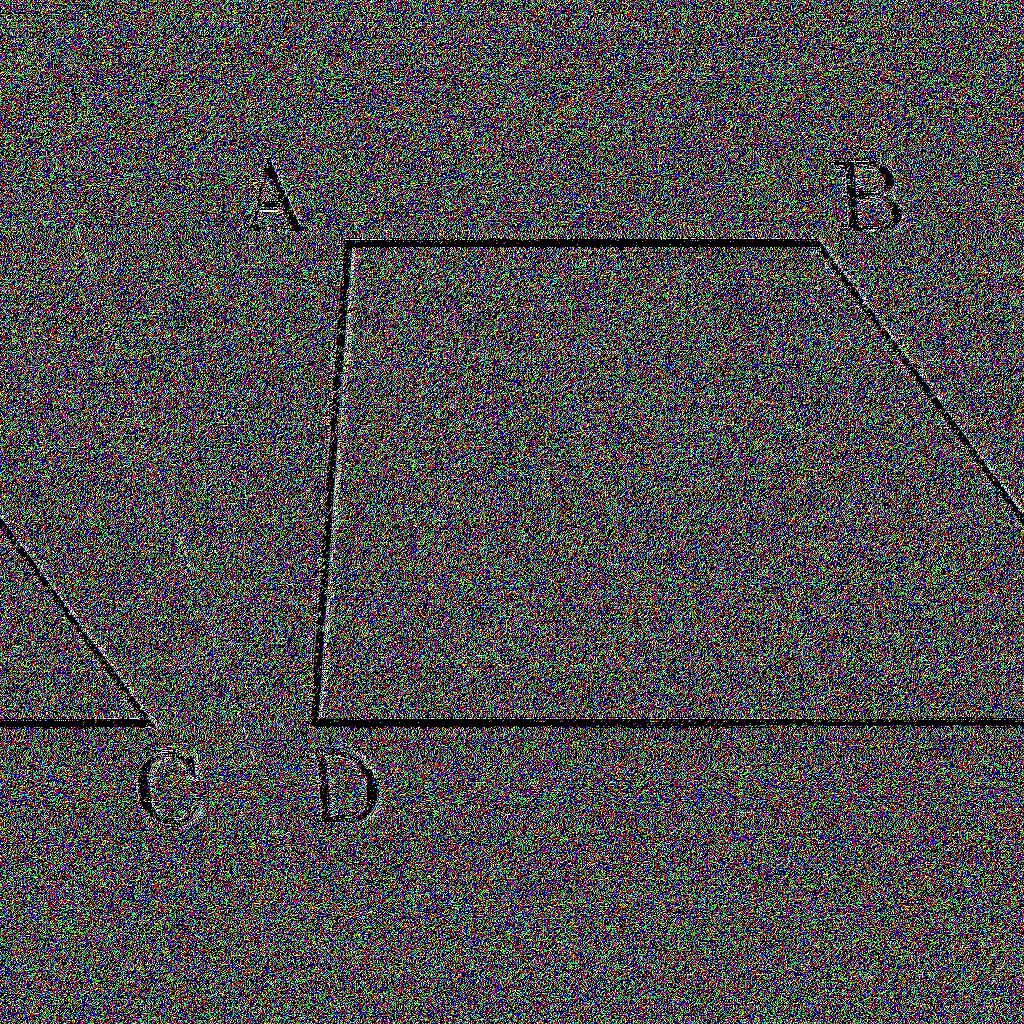
is calculated as A = (n + n + r) (n + r − n + 2(2n − 1))(n − n − r + 2(2n − 1))
(2n+r) 2 2 2 2 2
and after solving we get A = (4n − 2) − r . For area A ∈ Z, (4n − 2) − r = l for some integer l. This is of the form pythagorean equation [10] and it can be written as (4n − 2) = (u + v )k, r = 2uvk, l = (u − v )k, for some integers u, v, k. From this n can be written as (u + v )k 1 n = + (0.3)
. We consider four cases for n.
Case 1
Suppose u and v are even (ie., u = 2α, v = 2β(α, β ∈ Z)), then n = + (α k + β k) ∈ / N. This case fails.
Case 2
2 2 k 1
Suppose u and v are odd (ie., u = 2α + 1, v = 2β + 1 for some integers α, β),then n = (α +β +α +β)k + + .
Subcase 1
If k = 2γ + 1, γ ∈ Z, then n becomes (α + β + α + β)(2γ + 1) + γ + 1 ∈ N
Subcase 2
If k = 2γ, γ ∈ Z, then n = (α + β + α + β)2γ + γ + ∈ / N.
Case 3
2 2 k 1
Suppose u = 2α + 1, v = 2β(α, β ∈ Z. Then the value of n = (α + β + β)k + +
Subcase 1
4α+4β+4β +γ 1
If k = 2γ(∈ Z),then n = + ∈ N when γ is odd.
Subcase 2
2 2 γ 3
If k = 2γ + 1,then n = (α + β + β )(2γ + 1) + + ∈ / N.
Case 4
If u = 2α, v = 2β + 1(α, β ∈ Z. Proof is similar as above case. Hence, exccept the case 1, all others are possible ones.
Finding the integer area of isosceles trapezoid. The area of the given isosceles trapezoid is A =
((u +v )k+2+4uvk)(u k−v k) 2 2 2 2 2
. For area to be integer 8|((u + v )k + 2 + 4uvk)(u k − v k). Then ((u + v )k + 2 + 4uvk)(u k − v k) = 8z for some integer z.
For case 2
If u, v, k ≡ 1 (mod 2) .That is ((u + v )k + 2 + 4uvk)(u k − v k) ≡ 0 (mod 2).
For case 3
If u ≡ 1 (mod 2) and v, k ≡ 1 (mod 2) .Then is ((u + v )k + 2 + 4uvk)(u k − v k) ≡ 0 (mod 2).
For case 4
Similar as above.
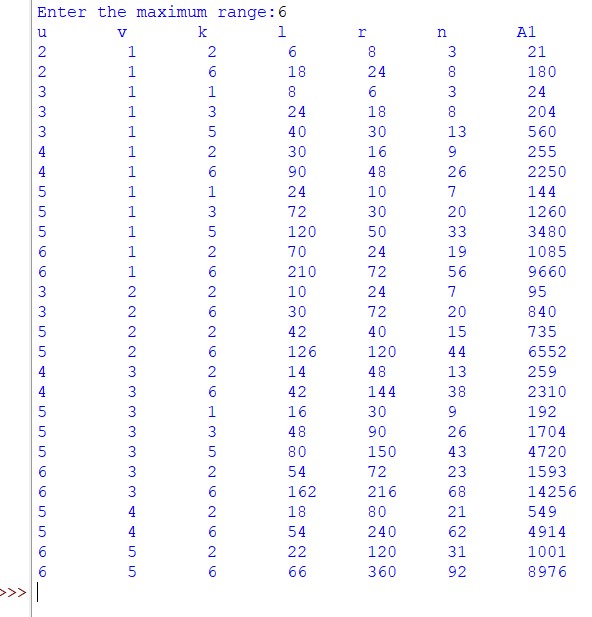
2.1 Python Programming for finding the integer area
1 #trapezium with the sides n,n+r,2n-1 ,2n-1 2 import math 3 from fractions import Fraction as frac 4 def trapezium () :
5 print('u\tv\tk\tl\tr\tn\tA1 ') 6 for v in range (1 , m +1) :
7 for u in range ( v +1 , m +1) :
8 for k in range (1 , m +1) :
9 l = u **2* k - v **2* k 10 r =2* u * v * k 11 m1 = u **2* k + v **2* k 12 n1 = u **2* k + v **2* k +2 13 if n1 % (4) == 0:
14 n = n1 //4 15 A1 = frac (( r +2* n ) * l ,4) 16 print(u ,'\t',v ,'\t',k ,'\t',l ,'\t',r ,'\t',n ,'\t', A1 ) 17 m =int(input("Enter the maximum range:") ) 18 #m is the maximum range 19 trapezium ()
Coding 1. Finding the integer area for thr isosceles trapezoid ABCD
3. Notations
The notations used in this article are as follows.
(1) P - Set of all primes
(2) B - 2n × 2n matrix which is constructed using the given message.
th
(3) Bk - k block of B with the size 2 (ie, 2 × 2 matrix).
(4) b - number of blocks of the matrix B.
(5) s = min{q ∈ P : q|b}
2 if b is 1 or 2n (n ∈ N) (6) p = s if b is 2n + 1(n ∈ N)
b if b ≤ p (7) r = p if b > p
(8) dk - determinant of the matrix Bk.
bk1 bk2 (9) - elements of Bk bk3 bk4
(10) E=[dk, bki]i=1,2,4 - encrypted matrix.
q q ∗
1 2 p r
(11) - elements of (Qa ) q3 q4
(12) δ -notation for space.
(13) (x, y) - Positive integer solutions of x − py = a
(14) a - Sphenic number
4. Character’s Position
Here, the integer area for the isosceles trapezoid that was gathered from the previous section is used to allocate the alphabets’ positions.
Table 1. Character’s Position
This table is shown in the PDF version of the article.
5. Algorithm
In this section, we present the encryption and decryption algorithms.
5.1 Encryption
(1) Using the given text we have to construct the matrix B of order 2n × 2n.
(2) Convert the matrix B into the block matrix Bk of the order 2 × 2.
(3) Finding the number of blocks b and select r using p and b.
(4) p can be choosen in two ways as given above.
(5) Choose any Sphenic number a as the product of three consecutive primes which depends on p.
(6) Instead of using the characters in Bk we apply their positions using the above table to find the elements of Bk.
(7) Find the determinant dk of the matrix Bk.
(8) Using the elements of Bk and their determinant we construct E.
5.2 Decryption
Using the encrypted matrix E we have to decrypt.
(1) Construct the (Qa ) .
p r ′
(2) We have the elements of (Qa ) as q s.
(3) Find ωk1 and ωk2, where ωk1 = q1bk1 + q3bk2 ,ωk2 = q2bk2 + q4bk2.
(4) Solve for tk using a dk = ωk1(q2tk + q4bk4) − ωk2(q1tk + q3bk4).
(5) Now substitute bk3 instead of tk.
(6) At last we construct Bk and B.
6. Encryption and Decryption for the word "ARC"
Encryption
(1) B =
(2) There is only one block and so b = 1.
(3) By definition of p and r, we have p = 2 and r = 1. Choose a = 2(5)(7) = 70.
91 2380 ′ (4) Thus B1 = and so b s are given by b11 = 91, b12 = 2380, b13 = 94, b14 = 0.
(5) d1 = |B1| = −223720
(6) E = −223720 291 2380 0
Decryption
∗ 210 280 (1) Q70 = .(The fundamental solution for x − 2y = 70 is (210, 140).)
(2) Here q1 = 210, q2 = 280, q3 = 140, q4 = 210
(3) ω11 = q1b11 + q3b12 = 335111 and ω12 = q2b11 + q4b12 = 525280.
(4) a d1 = ω11(q2t1 + q4b14) − ω12(q1t1 + q3b14) ⇒t1 = 229
(5) b13 = t1 = 94
(6) Hence we get B1 = from E.
(7) B =
7. Conclusion
p r 2 2 2
In this paper, (Qa ) constructed using the solutions of x − py = a using the choices of a and p. We encrypt and decrypt the message using the generalized Pell equation of the form x − dy = n where d and n are prime (p) and square of a sphenic number (a ) respectively. This content is the generalization of [3]. We may also extend this with any other Diophantine equation or we may use any other choices of a. We employ a few additional geometric forms for enhanced safety.
References
- [1] Dickson, L. E. (2015). History of the Theory of Numbers, Volume- II Diophantine Analysis. Dover Publications, New York.
- [2] Gould, H. M. (1981). A history of the Fibonacci Q-matrix and a higher-dimensional problem. Fibonnaci Quart, 19(3), 250-257, (1981). ∗
- [3] Kannan, J., Mahalakshmi, M., & Deepshika, A. (2022). Cryptographic Algorithm involving the Matrix Q . Korean J. Math, 30(3), 533-538. https://orcid.org/0000-0001-6197-2119
- [4] Mahalakshmi, M., Kannan, J., Deepshika, A., & Kaleeswari, K. (2023). 2-Peble Triangles Over Figurate numbers. Indian Journal of Science and Technology, 16 (44), 4108-4113. http://dx.doi.org/10.17485/IJST/v16i44.2663.
- [5] Mahalakshmi, M., Kannan, J., Deepshika, A., & Kaleeswari, K.(2023). Existence and Non - Existence of Exponen-tial Diophantine triangles over Triangular numbers. Indian Journal of Science and Technology, 16(41), 3599-3604. http://dx.doi.org/10.17485/IJST/v16i41.2338.
- [6] Mahalakshmi, M., Kannan, J., Deepshika, A., Manju Somanath, Vijaya Shanthi, P., & Kaleeswari, K.(2025). Diophantine Kites: Rational Diagonals and Integer Area Constructions. Communications on Applied Nonlinear Analysis, 32(7s), 01-12. http://dx.doi.org/10.52783/cana.v32.3334
- [7] Kannan, J., & Manju Somanath. (2023). Fundamental Perceptions in Contemporary Number theory, Nova Science Publisher, New York. https://doi.org/10.52305/RRCF4106
- [8] Kannan, J., Manju Somanath., Mahalakshmi, M., & Raja, K. (2022). Encryption Decryption Algorithm using solutions of Pell equation. International Journal for Research in Applied Science and Engineering Technology, 10(1), 1-8.
- [9] Sumeryra, U. C. A. R., Nihal, T.A.S., & Ozgur, N.Y., A new application to Coding theory via Fibonacci and Lucas numbers, Mathematical Sciences and Applications E-Notes, 7(1), 62-70, (2019).
- [10] Titu Andreescu., Dorin Andrica., & Ion Cucurezeanu. (2010). An introduction to Diophantine equations: a problem - based approach. Birkhauser, Boston.
- [11] Trappe, W., & Washington, L. C. (2006). Introduction to cryptography, Prentice Hall, New Jersey.
- [12] Telang, S. G. (1996). Number Theory, Tata McGraw - Hill Publishing Company Limited, New York.